 ANONAsymmetric and Narrated Outward-expansion Network
ANON: Asymmetric and Narrated Outward-expansion Network for Photo Composition Repair
1National Taiwan University2MediaTek Inc.3National Yang Ming Chiao Tung University
ANONAsymmetric and Narrated Outward-expansion Network
1National Taiwan University2MediaTek Inc.3National Yang Ming Chiao Tung University
 ANONplanner · Qwen3.5-4B LoRA
01Abstract
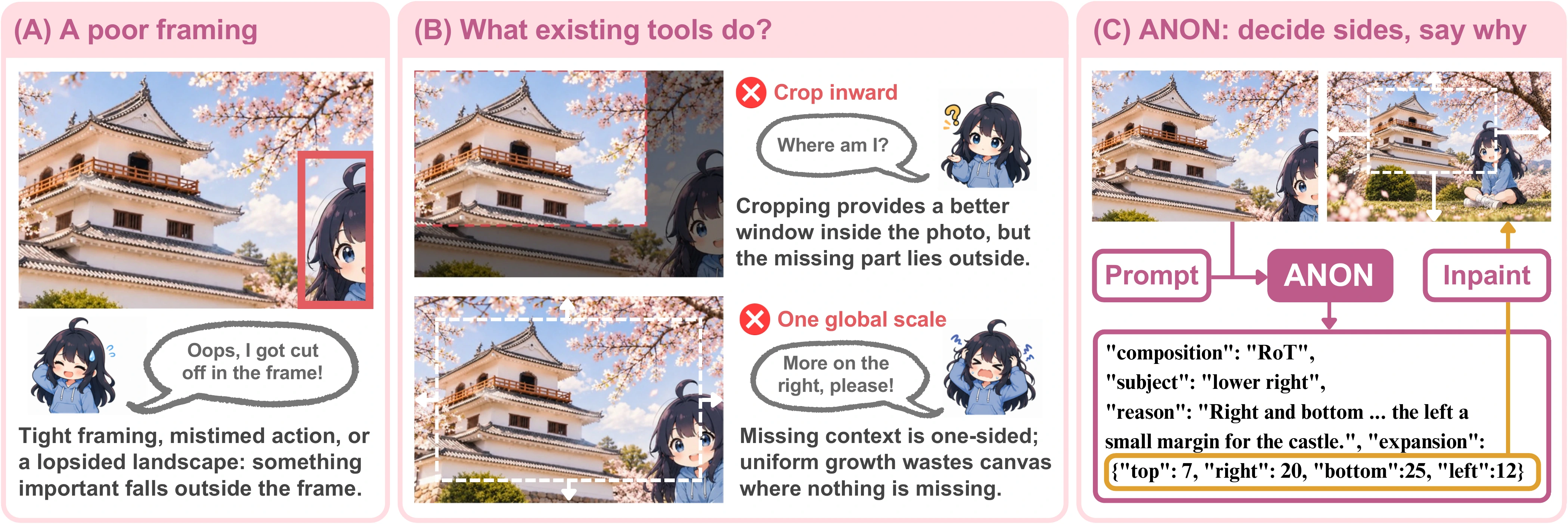
Outpainting models decide what to paint, but the sides to extend and the amount on each side are still set by the user. We present ANON (Asymmetric and Narrated Outward-expansion Network), a fine-tuned vision-language model that predicts four outward expansion percentages and a short rationale from a badly framed photo. It decides the asymmetric expansion in one step, and an interchangeable outpainter fills the new area. On 300 test crops, it reaches a canvas mIoU of 0.797, against 0.748 for the strongest closed-source frontier VLM with in-context examples and 0.691 for a constant expansion; its numbers-only variant reaches 0.789. In a user study, 74 participants prefer its frames to the frontier VLM's in 59% of trials. The numbers follow directional edits to the rationale on 82–91% of crops, while rewording leaves them unchanged; 90.6% of its verifiable claims are judged correct.
02Method
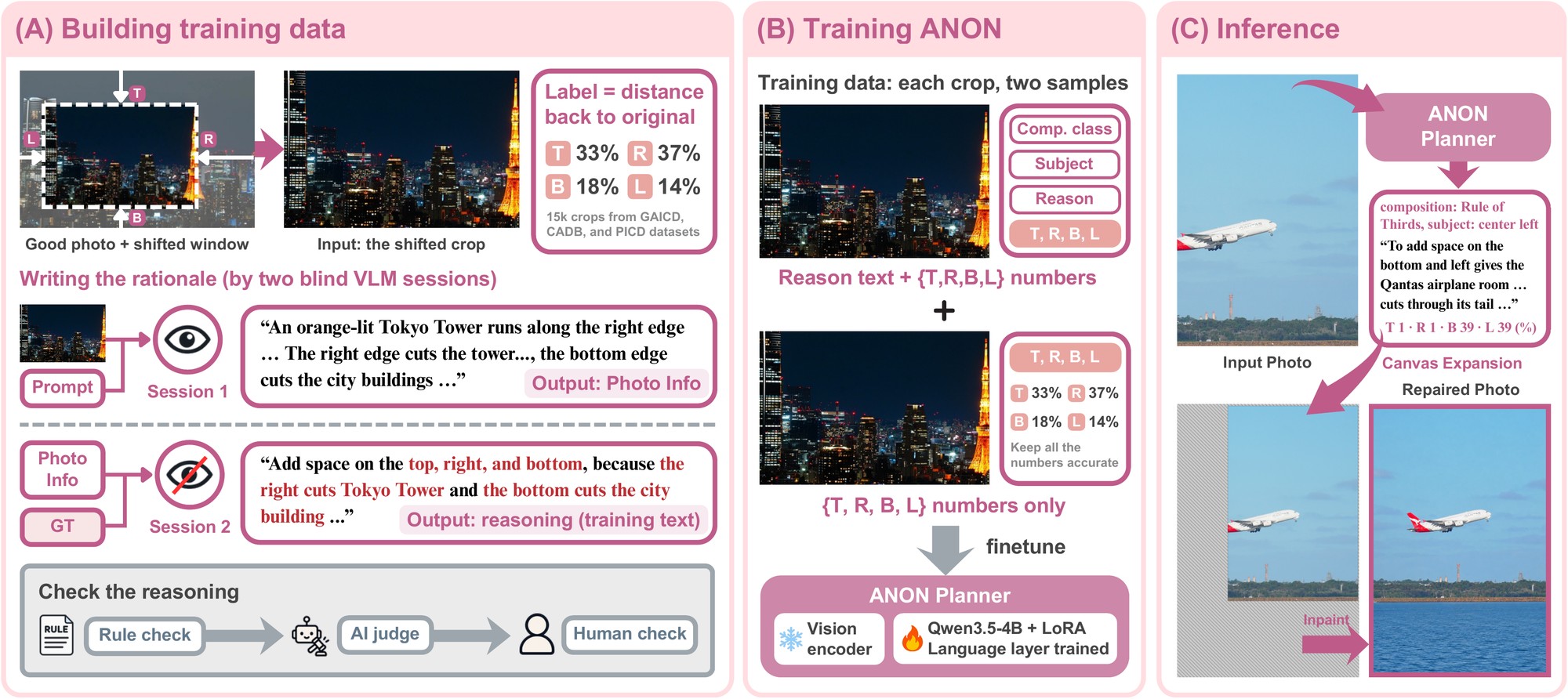


Overview. (a) Reverse cropping provides per-side distances to the reference frame (GT). Two isolated teacher sessions write the rationale: Session 1 sees the crop but not the answer and outputs an observation (Photo Info); Session 2 sees only facts (the observation, the subject cell and the GT sides to grow), never the image, and outputs the reasoning used as training text. Three checks follow: rules (names the sides to grow, no percentages, 20–150 words), an AI judge that re-reads the observation against the image (9.5% of rows flagged), and a person who checks every flagged row, edits the observation, then reruns Session 2 and the checks. (b) Each crop provides a rationale sample and a numbers-only sample; the vision encoder is frozen and the language layers are trained with LoRA. (c) The planner fine-tuned in (b) reads the photo and the prompt and predicts composition class, subject cell, rationale and four percentages; these expand the canvas, which an interchangeable outpainter fills.
03Comparison with baselines
Each planner sets its own canvas; all are filled by GPT Image 2.5. Red frame: the input pixels. Tag: IoU with the reference frame (the photographer's own).
Input crop
ANON's reasonExpanded canvas
Held-out test crops where the planners differ most; numbers over all 300 crops are in Results. Unlike the user study, where the planners' canvases are cut from one shared fill so that only the frame differs, every panel here is a separate generation, as in the paper.
04Results
300 held-out reverse crops unless stated. Canvas IoU is agreement with the photographer's own frame; it is a reference, not a unique right answer. Red = best, underline = second per column.
(a) input, (b) Pixel Auto Frame (Pixel-AF), its own decision and its own fill, (c) ANON with GPT Image 2.5, (d) Pixel's decision rendered with the same fill as (c).
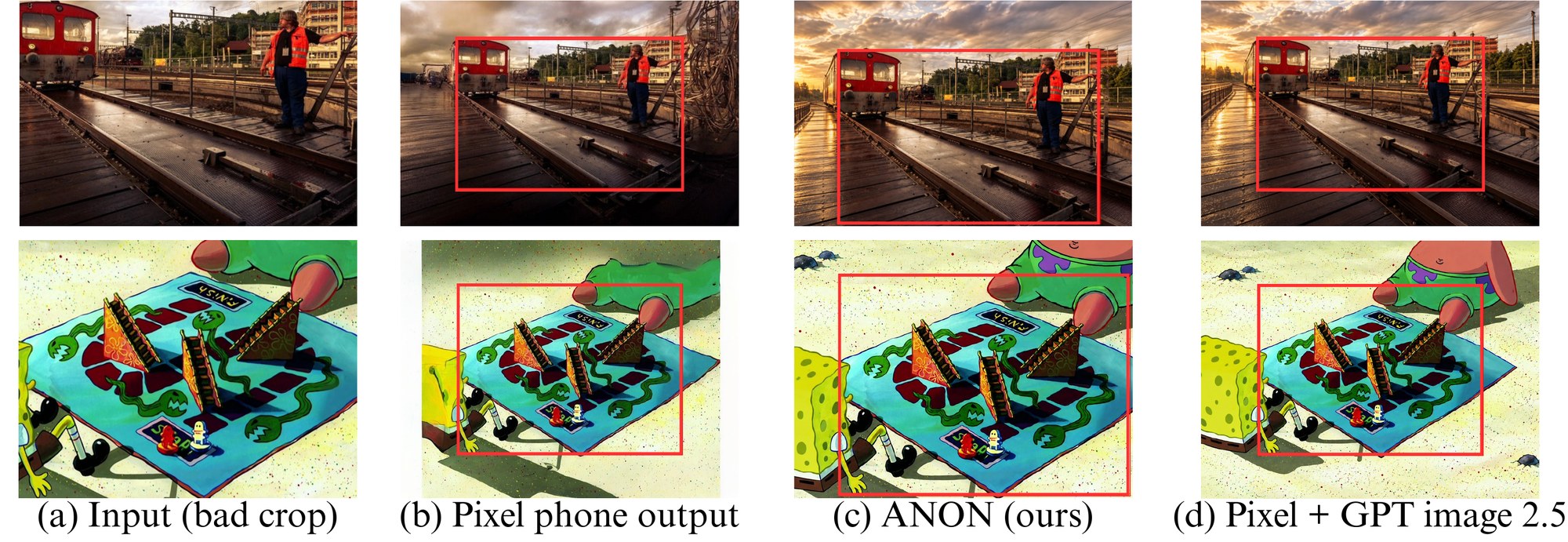
One canvas, five outpainters. The decision is the same; the fill is theirs.
The planner only outputs a canvas, so any masked inpainter can fill it. We use GPT Image 2.5 because it gave the best results on the same 102 canvases: in a blind check of 60 outputs, visible failures (seams, gibberish text, added frames or objects, blank fills) appear in 0% of GPT Image 2.5 outputs, about 7% of FLUX.1 Fill [dev] and about 83% of SDXL Inpainting. FLUX is close to GPT on the automatic metrics and is a usable local outpainter, for example when a commercial service declines a request.
05Inside the planner
While the planner writes the subject cell, heads 1, 6 and 11 of decoder layer 15 stay on the subject. Pick a photo, then a head, and switch LoRA off to compare.
The 16 heads of decoder layer 15 at the position where the planner writes the subject cell, numbered from 0. One crop per cell word: the first crop of the evaluation half that received it and has a usable mask; crops were not picked by looking at the maps. Heads 1, 6 and 11 were chosen on the first 150 test crops; each AUC is the mean over 96 crops of the other 150. With LoRA off: the base VLM on the same input and output. Maps are smoothed with a Gaussian of one image token and shown between their 5th and 99.5th percentile.
06Applications